
Tennis Retirement Betting Rules: Moneyline, Set and Game Handicap Settlement
A player can advance officially while your bet is still refunded. See how retirement timing and the selected market change the settlement.

Table of Contents
The Short Answer
There is no universal tennis retirement rule shared by every sportsbook. The official winner, the stage of the match and the exact market on your bet slip all matter.
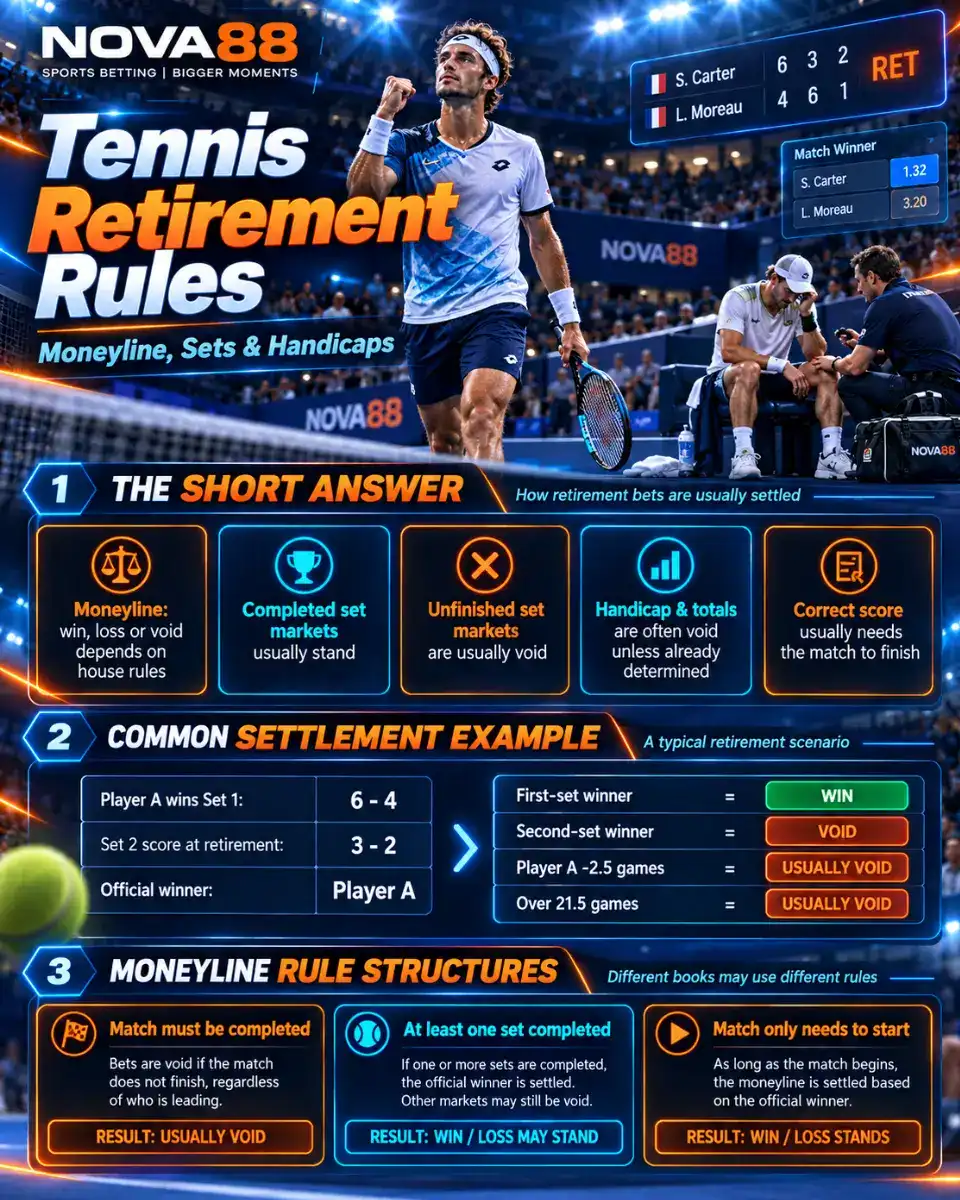
- Moneyline bets may win, lose or be void depending on the operator’s minimum-action rule.
- Completed set markets normally stand because their results cannot change.
- Unfinished set markets are commonly void unless already determined.
- Game handicaps and match totals often require match completion or an outcome that is mathematically certain.
- Correct match scores normally need the scheduled sets to be completed.
Retirement, Walkover and Disqualification
Retirement
The match starts and a player later stops because of injury, illness or another physical issue.
Walkover
A player withdraws before the first point. Bets on that individual match are normally void.
Disqualification
A player is removed for a rules violation. Settlement may differ from an injury retirement.
Do not assume that RET, W/O and DEF receive identical treatment. Some operators group retirement and disqualification together; others publish separate conditions.
One Retirement Can Produce Several Settlements
Consider a best-of-three match. Player A wins the opening set 6-4, leads the second set 3-2 and then Player B retires. Player A advances officially.
| Selection | Likely status | Reason |
|---|---|---|
| Player A moneyline | Rule dependent | Operators use different minimum-action rules |
| Player A to win Set 1 | Stands | The opening set was completed 6-4 |
| Over 9.5 games in Set 1 | Wins | Ten games were completed |
| Player A to win Set 2 | Usually void | The second set had no completed winner |
| Player A -2.5 games | Usually void | The final match margin is unknown |
| Over 21.5 match games | Usually void | The line was not reached before retirement |
| Player A to win 2-0 | Usually void | A second set was never completed |
The word “likely” is important. Tournament category, market wording and promotional retirement guarantees can change the result.
What Happens to a Tennis Moneyline Bet?
The moneyline—also called match winner or match odds—has the greatest variation between operators.
The Match Must Be Completed
Under a full-completion rule, a match that ends through retirement is void. The official winner does not automatically become the winning moneyline selection.
At Least One Set Must Be Completed
Some rules use the end of the first set as the dividing line. A retirement before that point voids the moneyline. After one completed set, the progressing player may be settled as the winner, although treatment of the retiring selection can still vary.
The Match Only Needs to Start
Other operators activate the bet once the first point is played. The retiring player may then be treated as the loser and the opponent as the winner.
How Set Bets Are Settled
Completed Set Winner
If the first set finishes 6-4 and a player retires during Set 2, the first-set winner normally stands. A later event cannot change the completed set result.
Completed Set Total
A 7-5 set contains 12 games. Over 10.5 wins and Under 10.5 loses even if the match later ends early.
Current or Next Set Winner
A retirement at 3-2 does not create a completed set winner. Current-set winner and correct-score bets are generally void.
Correct Match Score and Set Handicap
Selections such as 2-0, 2-1 or -1.5 sets usually depend on the completed match score. If retirement prevents the scheduled sets from being played, these markets are commonly void unless a listed outcome had already become impossible.
What Happens to a Game Handicap?
A game handicap applies a virtual advantage or disadvantage to the number of games won. Suppose Player A is backed at -3.5 games and leads 6-4, 3-2 when Player B retires.
Player A = 9 games
Player B = 6 games
Recorded margin = Player A +3 games
Player A is currently three games ahead, but the scheduled match did not finish. That does not automatically make -3.5 a losing bet. The remaining games could have changed the final margin, so the handicap is generally void unless the house rules state otherwise.
Are Missing Games Added to the Score?
Usually not. Do not invent a 6-0 score for an unfinished set or award every unplayed game to the non-retiring player unless the published rules explicitly use that method.
Championship Tie-Breaks
In some doubles formats, a championship tie-break replaces the deciding set. Many rules count it as one game for match-total and game-handicap settlement, not as ten or more separate games.

Total Games After a Retirement
When the Over Has Already Been Reached
Suppose the line is Over 18.5 games. The match reaches 7-5, 4-3 before retirement, producing 19 completed games. No future play could reduce that total. Under an already-determined rule, the Over may be settled as a winner.
When the Over Has Not Been Reached
If only 15 games were completed against Over 21.5, the selection is usually void rather than lost because the match could have crossed the line if play had continued.
Why an Under Is Not an Automatic Winner
An early stoppage should not manufacture an Under result. Under 21.5 after only 15 completed games is commonly void because the scheduled match was capable of producing more games.
Game and Point Markets
Small live markets depend on the exact moment play stopped.
- A completed fifth-game winner normally stands if retirement happens during the changeover.
- A current-game winner at 30-15 is normally void because the game was unfinished.
- First point, first ace or first break can stand once the named event occurs.
- A “race to three games” selection can stand after a player officially reaches three games.
Official feeds and tournament records help settle these markets. For a closer look at how fixtures, live scores and market information reach betting platforms, see the Betradar sports data overview.
What Does “Already Determined” Mean?
Rule pages may use “already determined,” “unequivocally determined” or “unconditionally determined.” They describe a result that no possible continuation of the match could change.
| Situation | Determined? | Explanation |
|---|---|---|
| Over 18.5 after Game 19 | Yes | The completed total cannot fall below 19 |
| First-set winner after 6-4 | Yes | The set has an official result |
| First player to serve an ace | Yes, after the first ace | The race market is complete |
| Player -3.5 match games | Usually no | Unplayed games could change the margin |
| Under 21.5 after 15 games | Usually no | A full match could exceed the line |
| Correct score 2-1 during Set 2 | No | The final set score remains unknown |
What Happens in a Parlay?
A void tennis leg commonly drops to decimal odds of 1.00 while the remaining selections continue.
Tennis selection: 1.75 → Void at 1.00
Basketball selection: 1.90
Revised odds: 1.80 × 1.00 × 1.90 = 3.42
Bet builders and promotional combinations may use different terms. If you compare the revised return in an Asian odds format, the Malay odds conversion examples show how positive and negative prices translate into decimal odds.
Check These Details Before Betting
- Open the tennis-specific rules instead of relying only on general house rules.
- Search for retirement, withdrawal, walkover and disqualification conditions.
- Confirm whether moneyline action needs one point, one completed set or full completion.
- Read the separate wording for handicaps, totals and correct scores.
- Check whether already-determined markets remain valid after retirement.
- Confirm how a championship tie-break is counted.
Rules can also vary by competition. ATP, WTA and Grand Slam events may not receive the same treatment as ITF, UTR or exhibition matches.
Final Takeaway
A tennis retirement does not create one settlement for every market. A completed first-set bet can stand while the moneyline follows an operator-specific rule and the match handicap is void.
Before using the sports markets at NOVA88, separate three questions: Did the match start? Was the selected market completed or mathematically decided? What does the applicable house rule say?
Frequently Asked Questions
What happens to a tennis bet if a player retires?
It depends on the sportsbook and market. Moneyline bets may win, lose or be void. Completed set markets usually stand, while unfinished handicaps, totals and exact scores are commonly void unless already determined.
Does the player who advances automatically win the moneyline?
No. Some operators settle the player progressing as the winner after a required stage, while others void the moneyline whenever the match does not finish naturally.
Is a walkover the same as a retirement?
No. A walkover occurs before the first point and normally voids bets on that match. A retirement happens after play begins and can activate different settlement conditions.
Does a completed first-set bet stand?
Normally yes. Once the set has an official result, a later retirement cannot change its winner, score or completed game total.
Is a game handicap void after retirement?
It commonly is because the final number of games is unknown. An exception may apply when the handicap result was already impossible to change.
Does an Over win if the line was reached before retirement?
It may be settled as a winner under an already-determined rule because completed games cannot be removed. Always confirm the operator’s exact total-games policy.
Does an Under win because the match ended early?
Usually not. The retirement prevented the scheduled match from finishing, so an Under that was not otherwise determined is commonly void.
What happens to a void tennis leg in a parlay?
A standard parlay normally continues with that leg recalculated at odds of 1.00. Bet builders and promotional products can have separate rules.
Are retirement rules identical at every sportsbook?
No. An operator may require the first point, one completed set or full match completion. Rules may also differ between major tours, ITF events and exhibitions.