

A badminton match ends in two games. You backed the Over. Is the bet automatically lost? Not necessarily. A close straight-games match can produce more points than a one-sided match that goes to a deciding game. The number of games matters, but the scores inside those games decide a match-total-points bet.
There is another reason to look closely at the bet slip: “total games” and “total points” sound similar, but they measure different things. If you are browsing the sports markets at NOVA88, start by checking the exact market label.
Table of Content
First, What Counts as a Match Point?
In badminton’s current standard 21-point format, the winner of each rally scores one point. A match is usually best of three games: the first side to win two games wins the match. At 20–20, a game continues until one side leads by two points; at 29–29, the next point ends it at 30–29. Badminton BC’s summary of the laws sets out these scoring rules.
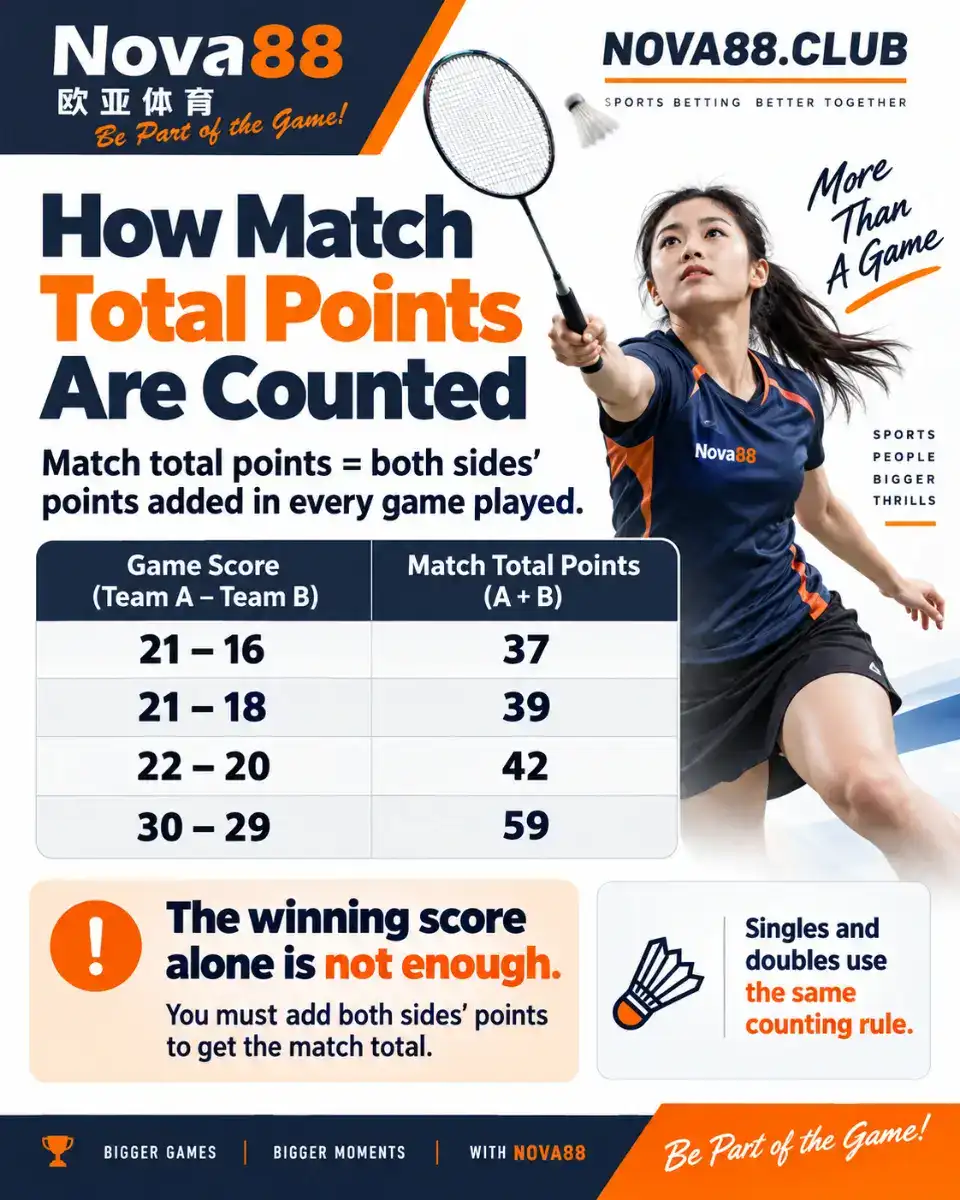
A 21–16 game contains 37 points, not 21. This works the same way when a doubles pair, rather than a singles player, earns the points for one side.
| Game score | Calculation | Points in that game |
|---|---|---|
| 21–16 | 21 + 16 | 37 |
| 21–18 | 21 + 18 | 39 |
| 22–20 | 22 + 20 | 42 |
| 30–29 | 30 + 29 | 59 |
The winning score alone does not tell you enough. A comfortable 21–8 game contributes 29 points; a close 22–20 game contributes 42.
Two Games Can Still Go Over
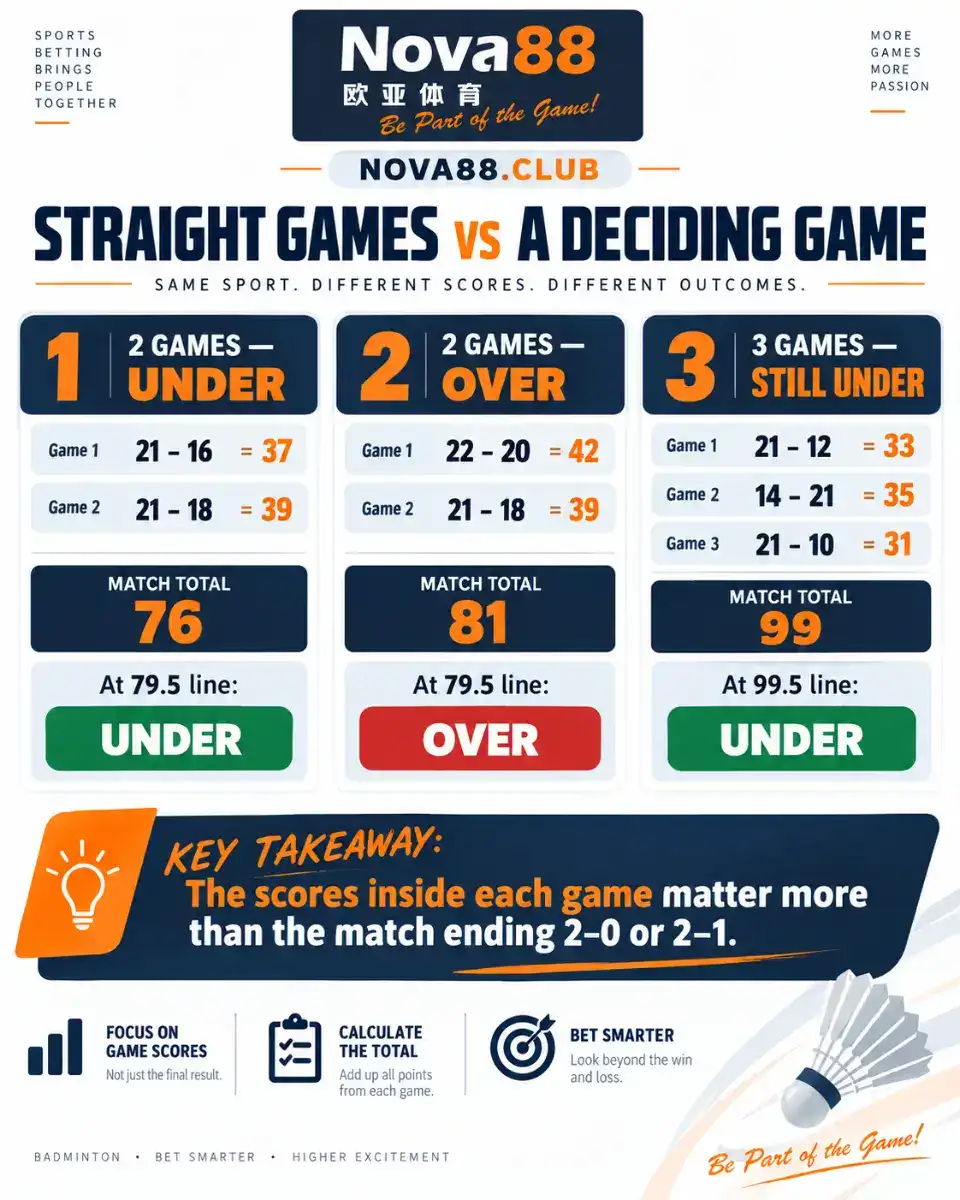
Suppose Player A wins 21–16 and 21–18. The match ends in straight games, with 37 + 39 = 76 total points. Against a match-total line of 79.5, Under wins.
Now imagine the first game is much closer:
2–0, but Under 79.5
21–16 = 37 points
21–18 = 39 points
Both games end before deuce.
2–0, but Over 79.5
22–20 = 42 points
21–18 = 39 points
The first game continues past 20–20.
Both matches finish 2–0. The second one collects extra rallies in its first game. That is the part a quick glance at “likely to win in two games” misses: a straight-games prediction is not an Under prediction by itself.
A Deciding Game Can Still Finish Under
A third game normally gives the match more opportunities to collect points. “Normally” is not “automatically.” Consider these scores, from Player A’s perspective:
| Game | Score | Combined points |
|---|---|---|
| Game 1 — A wins | 21–12 | 33 |
| Game 2 — A loses | 14–21 | 35 |
| Game 3 — A wins | 21–10 | 31 |
| Match total | 2–1 result | 99 |
Three fairly one-sided games can contain fewer points than the Over needs. The decider increases the number of games; it does not decide your match-points bet on its own.
“Over 2.5 Games” Is a Different Bet
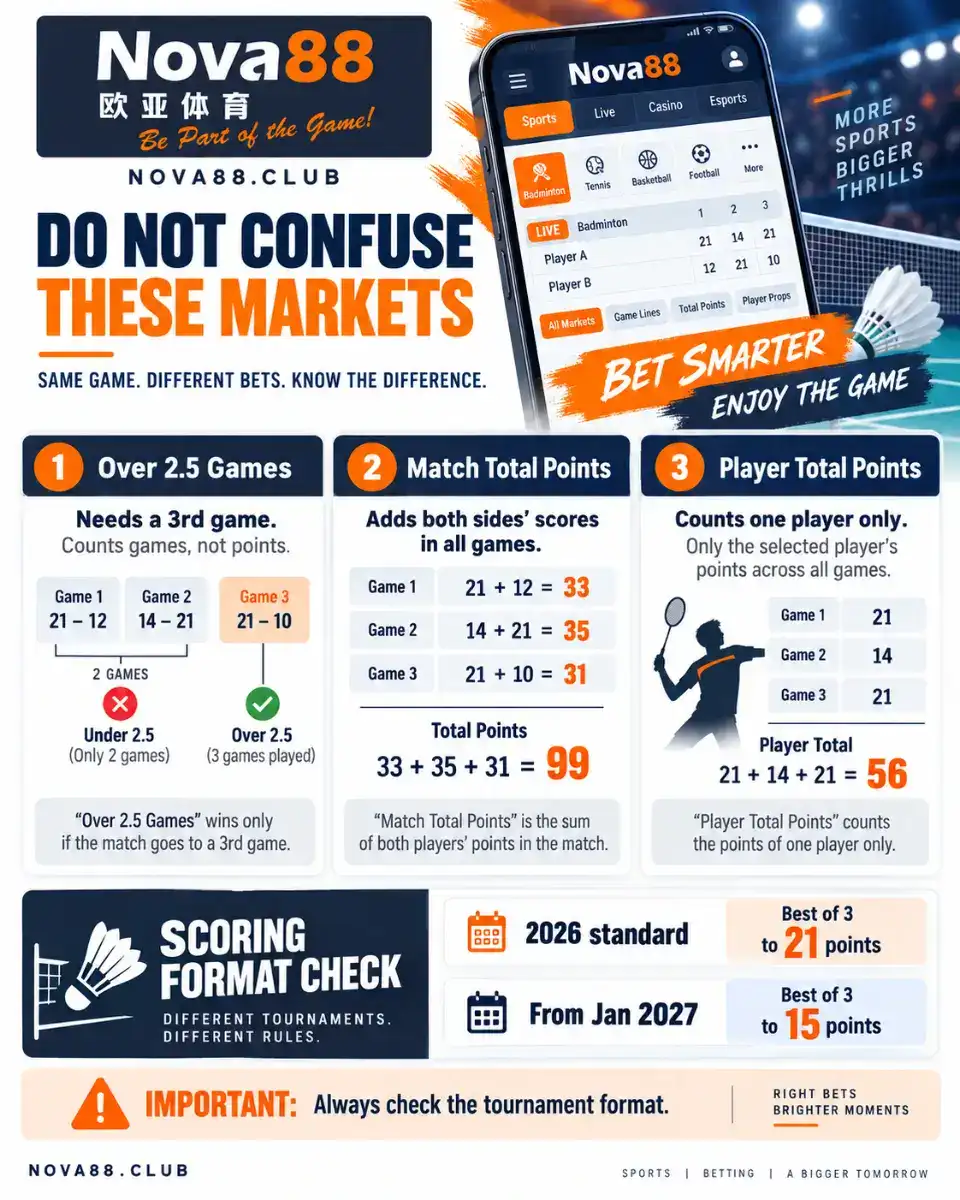
Total games asks whether a best-of-three match ends in two games or reaches a third. Over 2.5 Games wins if a deciding game is played. It says nothing about whether match total points exceed a line such as 99.5.
A player total points market is different again: it counts only the selected player’s scores. In the 21–12, 14–21, 21–10 example, Player A scores 21 + 14 + 21 = 56 player points, while the match total is 99.
Bookmakers treat these as distinct markets; Sky Bet’s badminton rules are one example.
The Close Game That Changes Your Total
At 20–20, a game has already produced 40 points but is not finished. Its earliest possible final score is 22–20, giving it 42 points. If neither side establishes a two-point lead, the score—and the match total—keep climbing. Under the current standard scoring format, a game can finish 30–29 for 59 points.
This does not mean a deuce game makes every Over a winner. Your bet still depends on the points line and all the other game scores. It does mean that a match heading towards 2–0 can add points faster than the game count suggests.
When a Live Over Is Already Certain
The first two games finish 21–16 and 19–21. Together, they contain 37 + 40 = 77 points. A third game begins. Does that immediately guarantee Over 99.5 Match Points? No. A deciding game could mathematically finish 21–0, adding only 21 points; the match would then contain 98.
Later, the deciding game reaches 15–8. That game has already produced 23 points, putting the match at 77 + 23 = 100 points. The Over 99.5 threshold has now been crossed: later rallies cannot remove points already scored.
At 15–8 in Game 3: 100 points already scored
A live score is useful, but official score records and settlement terms matter too. Our Betradar sports-data article explains the role of data feeds in betting markets. If a player retires or the match is abandoned, the operator’s rules decide whether a market stands or is void. For example, bet365’s badminton rules
The Scoring Change Coming in 2027
The calculations above use the standard best-of-three games to 21 points format in 2026. The Badminton World Federation has approved a move to best-of-three games to 15 points, scheduled to take effect on 4 January 2027, according to USA Badminton and Badminton Europe.
The way you add the two sides’ points remains straightforward, but totals from 21-point matches should not be reused as if they describe a 15-point match. Before comparing historical results, check the scoring format used by the specific competition and the rules for the specific market. A shorter format is not a guaranteed betting edge.
The Quick Check Before Choosing Over or Under
Look at your bet slip in this order: market name, points line, scoring format. Then picture plausible game scores, not just a 2–0 or 2–1 result.
- Straight games: two close games can still clear a modest match-points line.
- Deciding game: three one-sided games can still stay below a higher line.
- Live betting: “a third game has started” and “the Over threshold has been crossed” are not the same event.
And if your selection is shown in Malay odds rather than decimal odds, our Malay Odds Explained article covers the price and payout separately from the match-points calculation.
Frequently Asked Questions
Do points from both sides count towards badminton match total points?
Yes. A match-total-points market normally adds both sides’ scores in every included game. A 21–16 game contributes 37 points. Check the bookmaker’s market description for its exact settlement rules.
Does a badminton match that ends 2–0 always go Under?
No. Games ending 22–20 and 21–18 produce 81 match points. That is Over against a sample line of 79.5, despite a 2–0 result.
Does a deciding game guarantee Over on match total points?
No. Three games ending 21–12, 14–21 and 21–10 produce 99 match points. At a sample line of 99.5, Under wins.
Is Over 2.5 Games the same as Over on match points?
No. Over 2.5 Games asks whether a third game is played. Match points asks whether the combined scores exceed a stated points line.
Do extra rallies after 20–20 count towards the total?
Yes. Each scored rally adds one point. Under the current 21-point rules, a game at 20–20 finishes no earlier than 22–20, for 42 total points.
What if a badminton player retires during my total-points bet?
Settlement depends on the operator’s house rules and whether the selected market’s outcome was already determined. Check those rules before assuming the bet stands or is void.