
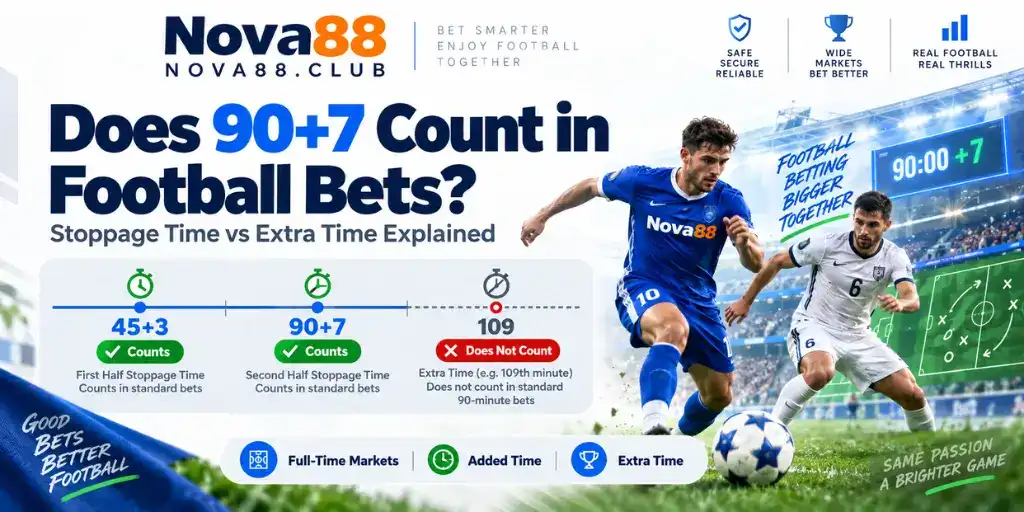
A team scores at 90+7. Does your football bet count it? For a standard 90-minute market, yes. Stoppage time is part of the match’s regular two halves. Extra time played after a tied cup match is another period entirely—and a bet slip can treat it very differently.
The useful question is not simply “What minute was the goal?” It is “Which part of the match did I actually bet on?”
Table of Content
Two Clocks on the Same Match
The match clock tells you when an event happened. The market on your bet slip tells you which playing period counts. They are related, but not interchangeable.
A regulation football match normally has two 45-minute halves. The referee can allow additional time in either half for interruptions, including injuries, substitutions, celebrations and VAR checks. The number announced by the fourth official is a minimum; the referee can play more. This is set out in the IFAB’s Law 7 on match duration.
First-half stoppage time. It can affect first-half and full-match markets.
Second-half stoppage time. It can affect standard 90-minute markets.
Extra time after regular time ends. It needs a market that includes that period.
Penalty kicks after the match. They do not add goals to the 90-minute score.

A detail worth checking: a penalty scored at 90+7 can change a standard full-time result. A kick taken in a penalty shootout cannot. A shootout occurs after the match and determines who advances where competition rules require it; see IFAB Law 10.
Does Stoppage Time Count in a 90-Minute Bet?
Yes, under the usual 90-minute football market rule. “90 minutes” means both regulation halves and the stoppage time actually played in them. It does not mean that all events at 90:01 are ignored.
Say you backed the home team in a full-time 1X2 market. The score is 1–1 when the clock reaches 90:00, then the home team scores at 90+6. If the referee ends regular time at 2–1 and the goal stands, the 90-minute home selection wins. The market is not settled as a draw just because the goal came after minute 90.
The easiest way to read it: second-half added time belongs to the second half. The regular-time result is known when that half ends—not when a live clock first displays 90:00.
Sky Bet’s football match rules explicitly include referee-added time in its normal 90-minute settlement. An operator may specify different terms for an unusual match format or a separately labelled market, so check the rules attached to your own selection.
One Match, Different Winning Selections
Now imagine a single-match cup tie that needs a winner. Watch how one late equaliser and one extra-time goal create two valid scorelines:
- Home team scores in the 35th minute: 1–0.
- Away team equalises at 90+6: 1–1 after regular time and stoppage time.
- Home team scores again in extra time: 2–1 after extra time.
The final fixture score might say 2–1, but a standard 90-minute bet is still judged at 1–1. These example outcomes assume the named markets use their usual stated periods:
| Selection | Period used | Result |
|---|---|---|
| Full-time 1X2: Draw | Regular time + stoppage | Wins |
| Full-time 1X2: Home | Regular time + stoppage | Loses |
| Correct score: 1–1 | 90-minute score | Wins |
| Over 2.5 match goals | Standard 90-minute market: two goals | Loses |
| Both teams to score: Yes | Both scored before regular time ended | Wins |
| Home team to qualify | Team progressing under this market’s rules | Wins |
| Extra-time correct score: 1–0 | Extra-time period only, starting at 0–0 | Wins |
This is not a loophole or a conflicting score feed. The fixture’s final score and the score used by an individual betting market can differ. Betfair’s 90-minute rule gives the same distinction between a regular-time draw, a later extra-time winner, and the extra-time-only correct score.
Which Markets Usually Stop After Stoppage Time?
A standard full-time match result normally stops when regulation time and its added time finish. Standard correct score, match goals over/under, team goals and both teams to score are commonly presented on the same basis—unless their market wording states otherwise.
A first-half bet stops at the referee’s half-time whistle, including first-half injury time. A goal at 45+4 can change a half-time result. A goal at 90+4 cannot.
Where Extra Time Can Count
Look for wording such as “to qualify,” “to lift the trophy,” “including extra time,” “after extra time” or the name of an extra-time market. A team can draw a 90-minute 1X2 market while still winning a separately offered qualification selection.
An extra-time correct-score market also has its own starting point: it looks at goals in the extra-time period, treating the period’s score as 0–0 at its start. If a tied match ends 2–1 after just one extra-time goal, the extra-time score is 1–0—not 2–1.
The exception people miss: player props may use a different clock from match or team markets. bet365’s football statistics rules distinguish match/team statistics settled after 90 minutes from named player markets that include extra time. Other operators or specific markets can differ; always read the exact player selection.
A live statistics feed can help you check whether an event was officially recorded, but a feed does not decide which period your slip covers. If you want to understand how match events reach betting screens, NOVA88 has a separate look at Betradar sports data. For settling this bet, the market wording and the operator’s rules still come first.
Why “90+5” Is Not an Automatic Finish Line
Suppose five added minutes are announced. At 90+4, a player needs treatment and play pauses. The referee allows the half to continue, and a goal is scored at 90+7. If the goal stands and happens before the regular-time whistle, it can still count in a 90-minute market.
The announced number is a minimum allowance, not a timer that invalidates events after it. A VAR review can also delay confirmation of a stoppage-time goal. The decision arriving later does not, on its own, turn the original event into an extra-time goal.
If a bet settlement seems to disagree with a live tracker, check the official match record, the period named on the bet slip and the operator’s data source. A displayed final score is useful, but it is not a replacement for the market’s settlement rule.
A Quick Bet-Slip Check
On a mobile screen, “Full Time,” “Match Winner” and “To Qualify” can sit close together. Before confirming a selection, check these four details:
- Market name: Is it a 90-minute result, first half, extra time, qualification or player prop?
- Period covered: Does this exact market include added time, extra time or shootouts?
- Fixture format: Is the game a normal league match, a cup tie or a match with an unusual scheduled length?
- Price and stake: Are you reading the potential payout separately from the settlement conditions?
A late goal can change a match and its odds. It does not retroactively change the period specified on your bet slip.
Frequently Asked Questions
Does a goal at 90+10 count in a full-time football bet?
Usually yes, if it occurs during second-half stoppage time before the regular-time whistle and the goal stands. Announced added time is a minimum, not an automatic cut-off.
Does first-half injury time count in a half-time bet?
Yes. First-half markets normally include the added time played before the referee ends the first half. Check the rules for your specific selection.
Does extra time count in a standard 1X2 bet?
Generally no. Standard 90-minute 1X2 includes stoppage time but not the extra-time periods after a cup draw. A separately labelled market may have different rules.
Can a team qualify while my bet on them to win loses?
Yes. A team can draw after 90 minutes, then advance in extra time or a shootout. Its standard 90-minute win selection can lose while its “to qualify” selection wins.
Does extra time count in an over/under goals bet?
Not in a standard 90-minute goals market. It may count when the specific market expressly includes extra time. Read the wording on the slip.
Do shots, bookings and player props always end at 90 minutes?
No. Operators can use different time rules for player, team and match statistics. Some named player props include extra time, so check the rule for the exact selection.
Do shootout goals count toward the 90-minute correct score?
No. A penalty shootout takes place after the match. Its kicks do not add goals to the regular-time score; shootout and qualification markets have their own rules.